Are Cascade utilization technologies of spent power batteries sustainable?
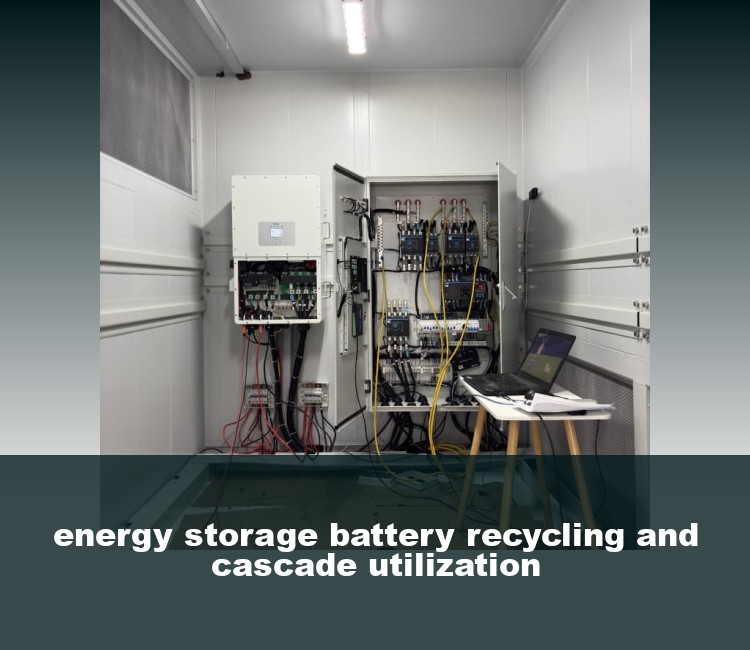
And it is an industry consensus to promote the sustainable development of the cascade utilization industry of spent power batteries. In this work, the cascade utilization technologies of spent power battery in the field of energy storage are systematically described.
Why is Cascade utilization of power batteries important?
The cascade utilization of power batteries holds tremendous potential and serves as an effective means to address energy and environmental challenges, driving sustainable development.
Can scrapped power batteries be used in Cascade utilization scenarios?
Therefore, research on scrapped power batteries should enable the regrouping battery packs to be directly applied to cascade utilization scenarios, and effective methods should be proposed to efficiently cluster and regroup large-scale spent power batteries in the future .
What are the economic benefits of Cascade utilization of retired power batteries?
This study analyzes the economic benefits of cascade utilization of retired power batteries, focusing on two key applications: grid energy storage and China Tower base stations. Currently, these account for 31 % and 52 % of second-life battery use, respectively, with a smaller portion used in low-speed EVs (Hu et al., ).
What is Cascade utilization of spent power batteries in China?
Some application cases of cascade utilization of spent power batteries in China. The project is used to adjust the transformer power output, stabilize the node voltage level, and be able to operate off-grid. China Tower currently has more than 1.9 million base stations, and the battery required for backup power is about 44Gwh.
How can a large-scale Cascade utilization of spent power batteries become a reality?
Only by reducing the application cost to a reasonable range, the large-scale cascade utilization of spent power batteries can become a reality. Reasonable capacity allocation is conducive to the smooth implementation of demonstration projects. However, there are still challenges to achieving an optimal configuration.
退役动力电池回收及其在储能系统中梯次利用关键技术
The study discusses the battery recycling mode, aging principle, detection, screening, capacity configuration, control principle, battery management system, and other technologies from the
Decisions for power battery closed-loop supply chain: cascade
Batteries that meet the criteria for energy storage applications can be sold to a storage station for cascade utilization, while the remaining depleted batteries undergo resource
From wastes to resources: the future of residential EV batteries in
These findings provided robust quantitative evidence to guide differentiated policy design and infrastructure investment, supporting the development of a circular battery economy critical for
A Review of Research on Power Battery Recycling and
This paper discusses the latest research results in the field of power battery recycling and cascade utilization, and makes a comprehensive analysis from four key dimensions: technical
Tripartite Evolutionary Game Analysis of Power Battery Cascade
Improving the full lifecycle value of power batteries and recycling necessary materials has recently emerged as a hot issue. Cascade utilization, disassembly and recycling of power batteries are
Energy storage utilization of cascade batteries
The cascade utilization of power batteries holds tremendous potential and serves as an effective means to address energy and environmental challenges,driving sustainable development.
Tax policy for reverse supply chain with battery cascade utilization
This paper constructs a supply chain game model consisting of a battery manufacturer, an EV manufacturer, and a grid company. Based on which, we investigate the
BYD Energy
As a global pathfinder, leader and expert in battery energy storage system, BYD Energy Storage specializes in the R&D, manufacturing, marketing, service and recycling of the energy storage products.
From wastes to resources: the future of residential EV batteries in
This study analyzes the economic benefits of cascade utilization of retired power batteries, focusing on two key applications: grid energy storage and China Tower base stations.
From wastes to resources: the future of residential EV batteries in
This study developed a scenario-based, province-level model to forecast the temporal and spatial distribution of retired EV batteries, evaluated their second-life energy storage potential, and
A Review of Research on Power Battery Recycling and
By reconstructing the battery connection topology in real time, this technology effectively alleviates the inherent defect of poor consistency of retired batteries, and provides a practical
From wastes to resources: the future of residential EV batteries in
From wastes to resources: the future of residential EV batteries in China through cascade utilization, recycling, and energy storage☆
Residual capacity estimation and consistency
Optimize battery cascade utilization: In terms of battery cascade utilization, accurately estimating the remaining capacity and conducting consistency sorting can reasonably categorize retired
A Deep Dive into Spent Lithium-Ion Batteries: from Degradation
To address the rapidly growing demand for energy storage and power sources, large quantities of lithium-ion batteries (LIBs) have been manufactured, leading to severe
An electricity-driven mobility circular economy with
Results show that lifecycle zero-carbon battery can be achieved under energy paradigm shifting to positive, V2X interaction, battery cascade utilization and battery circular economy in various
Technical-economic analysis for cascade utilization of spent
From the perspective of spent power battery recycling and cascade utilization of energy storage system, related technologies are discussed, including aging factors, detection,
Tripartite Evolutionary Game Analysis of Power Battery Cascade
The continued industrialization of new-energy vehicles has facilitated the rapid growth of the massive retired power battery drive recovery and cascade utilization industries. Improving the
Research on Development Trend and Policy System of Cascade Utilization
China's retired power battery echelon utilization technology is developing rapidly. As an effective way to promote China's "double carbon target" , the industrialization of retired
Current Challenges in Efficient Lithium‐Ion
Repurposing (or cascade utilization) of spent EV batteries means that when a battery pack reaches the EoL below 80% of its original nominal capacity, [3, 9] individual module or cell can be analyzed to
Environmental life cycle assessment on the recycling processes
Of the three LFP batteries recycling processes, the cascade utilization technology and hydrometallurgy produced relatively considerable resource and environmental
Life cycle assessment and carbon reduction potential prediction of
Results show that: (1) The production stage of EVs battery with the carbon emission of 105 kgCO2-eq/kWh, which has the most significant impact on the environment. (2)
Current Challenges in Efficient Lithium‐Ion
Repurposing (or cascade utilization) of spent EV batteries means that when a battery pack reaches the EoL below 80% of its original nominal capacity, [3, 9] individual module or cell can be analyzed to
Life cycle assessment and carbon reduction potential prediction of
Results show that: (1) The production stage of EVs battery with the carbon emission of 105 kgCO2-eq/kWh, which has the most significant impact on the environment. (2)
From wastes to resources: the future of residential EV batteries in
From wastes to resources: the future of residential EV batteries in China through cascade utilization, recycling, and energy storage
Research on recycling benefits of spent lithium batteries with
Abstract The sales of new energy vehicles continue to grow, the problem of recycling spent lithium battery has become the focus. In this work, a cost-income model for
From wastes to resources: the future of residential EV batteries in
Semantic Scholar extracted view of "From wastes to resources: the future of residential EV batteries in China through cascade utilization, recycling, and energy storage." by
A novel clustering algorithm for grouping and cascade utilization
The rapid deployment of lithium-ion batteries in clean energy and electric vehicle applications will also increase the volume of retired batteries in
梯次利用动力电池规模化应用经济性及经济边界分
First, the cost types of the cascade energy storage system are analyzed, and its cost sensitivity parameters are analyzed using the levelized cost model. Second, it analyzes the current state of echelon usage of decommissioned
Multiple benefits of new-energy vehicle power battery recycling
With the yearly increasing market penetration of new-energy vehicles in China, the retirement of power batteries has gradually become a scale, and most of the waste
(PDF) Research on Cascade Utilization and
With the development and popularization of electric vehicles, the number of decommissioned power batteries increases progressively year after year, urgently requiring the cascade utilization and
From wastes to resources: the future of residential EV batteries in
The rapid adoption of residential electric vehicles (EVs) in China presents significant challenges for the sustainable management of end-of-life (EOL) traction batteries. This study developed a
Lifecycle battery carbon footprint analysis for battery sustainability
A cross-scale multi-stage analytic platform with inter-disciplinary and trans-disciplinary is formulated, involving battery materials (anode, cathode, electrolyte),
退役动力电池梯次利用研究进展
Through the analysis of different energy storage scenarios of cascade batteries such as the charging stations, communication base stations, photovoltaic power plants, and
From wastes to resources: the future of residential EV batteries in
This study developed a scenario-based, province-level model to forecast the temporal and spatial distribution of retired EV batteries, evaluated their second-life energy storage potential, and
Discussion & Message Board
Comments saved locally (demo). Replace with server endpoint for production.